In this review, I will demonstrate how to insert an indwelling Foley catheter in a male patient.
First, confirm that you have an order for the procedure, then verify the patient rights to ensure you have the correct patient and are performing the right procedure. Next, educate the patient about what will happen and answer any questions they may have. This is also a good time to check for any allergies, particularly to iodine and latex. If the patient has these allergies, make sure you have the appropriate supplies on hand.
Position the Patient for Foley Insertion
It’s a good idea to have someone assist you with this procedure, as an extra set of hands can be very helpful. Gather your supplies, perform hand hygiene, and don a pair of clean gloves. Next, adjust the bed to a comfortable height to avoid straining your back, and position the patient. For a male patient, have them lie back with their legs extended and apart. During positioning, place a waterproof pad under the patient to protect the linen and facilitate cleanup.
Video on Inserting a Foley Catheter in Male Patient
Periurethral Care (Peri-care) Before Insertion
Once you’ve done that, remove your gloves, perform hand hygiene again, and put on another pair of clean gloves.
Now, prepare for peri-care/peri-urethral. Some Foley kits provide Castile (soap wipes) within the plastic bag outside of the CSR wrap to help assist with peri-care.

To open the plastic bag (not the CSR wrap that contains the sterile catheter tray) remove the tab and pull out the kit while discarding the bag to the side. You’ll find instructions for use and the peri-urethral care supplies.
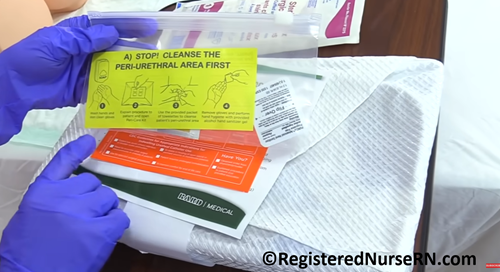
Before performing peri-care, assess the penis to determine whether it is circumcised or uncircumcised. If the patient were uncircumcised, you would need to retract the fold of skin covering the glans (the head of the penis) to expose the urinary meatus.
Now, I’ll use the Castile wipes to assist with peri-care. I’ll open the first wipe and clean the urinary meatus area first. Using my non-dominant hand, I will hold the penis at the shaft. If the penis was uncircumcised, I would retract the skin back before cleaning. I’ll start at the urinary meatus and clean in a circular motion, then discard the wipe.
Next, I’ll take the second wipe and clean from the top of the shaft downward in a circular motion, going all the way to the base before discarding it. For the third wipe, I’ll clean each side of the groin and then the scrotum, extending from the front to the back toward the anus. Once that’s completed, I’ll remove my gloves and perform hand hygiene.
Preparing Foley Catheter Kit
Now, I’ll prepare to open the actual Foley tray that contains the supplies for insertion. I’ll place the unopened tray between the patient’s legs and orient it toward the insertion side, as indicated by the arrow on the kit. I’ll carefully open the CSR wrap, peeling it back to avoid contaminating the sterile contents. See video on how to properly do this.
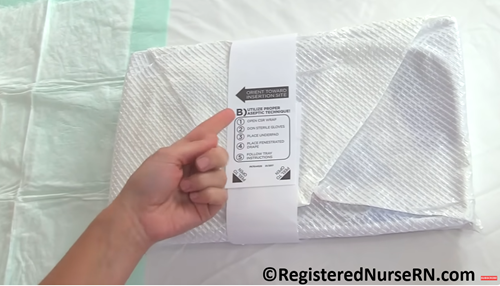
The first thing I need to do is grab the sterile gloves from the kit. These should always be on the top for easy access. I’ll place them on a clean surface to put them on. Once I’ve opened the gloves, I’ll don my dominant hand first by grabbing the inside cuff and putting my fingers in. Then, I’ll use my sterile hand to pull on the cuff of the non-dominant glove and adjust them accordingly.

Next, I’ll drape the patient with the two drapes provided in the kit to extend the sterile field. The first drape is an underpad with a dull side and a shiny side; the shiny side goes up. I’ll let it drape over my gloves and have my assistant lift the patient slightly to place it underneath without contaminating my gloves.
The second drape has a hole for the penis, also with a dull side and a shiny side. I’ll let this drape over my hand and position it so that the penis is in the hole. Now I’m ready to prepare the inside contents of the kit.

I’ll open the iodine and pour it onto the swabs. Next, I’ll attach the sterile water syringe to the Foley catheter. It’s important to note the size of the catheter; in this case, it’s 14 French. I’ll place the syringe in the port without checking the balloon, as doing so can change its shape and potentially cause tears in the urethra. Note: most manufacters say to NO longer pre-test the balloon by inflating and deflating it prior to insertion (always follow facility’s protocols).
Now I’ll apply lubricant to the catheter. For male patients, healthcare providers may order a lubricant with lidocaine to ease discomfort during insertion. Always confirm you have orders for this.

Next, I’ll coat the catheter generously with lubricant, typically about 5 to 7 inches, as per hospital protocol.
Inserting the Foley Catheter
Once that’s done, I’ll clean the penis with iodine before insertion. Using my non-dominant hand to hold the penis (this hand MUST stay here until insertion is over), I’ll start at the urinary meatus and clean in a circular motion all the way down to the base, then discard the swab.
I’ll repeat this with a second iodine swab and then a third, following the same procedure. If the healthcare provider ordered lubricant to be instilled inside the urinary meatus, I’ll hold the penis at a 90-degree angle, insert the tip of the syringe, and slowly instill the prescribed amount.
After disposing of the syringe, I’ll wait up to three minutes if the lubricant contains lidocaine, allowing it to numb the area before insertion. Once the time has passed, I’ll grasp the catheter tubing about five inches from the tip and hold the penis at a 90-degree angle for insertion. I’ll instruct the patient to breathe in and out to help relax the urethra. When I hear the patient exhale, I’ll insert the catheter.
I’ll advance it until I reach the bifurcation, confirming that I am in the bladder. Follow your hospital’s protocol for how far to insert the catheter. Once I’ve confirmed correct placement, I’ll remove my non-dominant hand from the penis and hold the catheter in place to prevent it from retracting back into the bladder.
Using my dominant hand, I’ll inflate the balloon. The patient should not experience any pain during this process. After inflating the balloon, I’ll disconnect and discard the syringe, then gently pull back on the catheter to ensure the balloon is positioned in the bladder. If the patient is uncircumcised, I will need to reposition the foreskin back over the penis.
How to Secure a Foley Catheter with StatLock Stabilization Device
Now it’s time to secure the catheter according to your facility’s protocols for male patients. Generally, you’ll extend the leg and place the catheter on the upper front part of the thigh. For long-term indwelling catheters, position it on the lower abdomen with the penis pointing toward the stomach to prevent erosion of the urinary meatus.
To secure the catheter, I’ll place it in the provided StatLock ensuring the arrow points toward the insertion site. Next, I’ll select a spot for the StatLock. The patient’s leg should be fully extended, and I’ll ensure there’s some slack in the catheter line.
After cleaning the area with an alcohol prep pad and allowing it to dry, I’ll apply a skin protectant to safeguard the patient’s skin since stat locks are typically left on for a week. While waiting for the area to dry, I’ll initial and date the insertion site for future reference.
Once dry, I’ll position the StatLock on the skin, ensuring the arrow is still pointing toward the insertion site. Now, I’ll position the drainage bag, ensuring it remains below the patient’s bladder at all times, never on the floor or in a movable part of the bed. The tubing should be straight, without kinks or loops, allowing for proper drainage.

I’ll place the drainage bag at the foot of the bed and use a sheet clip to keep the tubing straight. Finally, I’ll place any necessary stickers from the tray, clean up my supplies, make the patient comfortable, remove my gloves, perform hand hygiene, and document the procedure.
That concludes this demonstration. If you’d like to see an insertion of catheter on female, please click the provided link.
Foley Catheter Urine Collection Bag Placement
After securing the device, place the urine collection bag at the foot of the bed by hanging it on a non-movable part of the bed.

It is very important that the collection bag stays below the bladder at all times, is never on the floor, and is emptied routinely.
The drainage tubing should be secured to the bedsheets with the sheet clip on the drainage tubing. This tubing should never be kinked or looped. Instead, it should be positioned in a straight line so gravity can easily drain the urine.
Once this has been done, apply any stickers to the catheter and the patient’s chart per your facility’s protocol.
Clean up the materials, cover up the patient, doff gloves, and perform hand hygiene. Then, document the procedure.
More Nursing Skill Videos
References:
Bard Medical. (2016). SureStep Post Insertion Foley Catheter Care. Covington, Georgia; C.R. Bard Inc.
Lynn, P. (2014). Unit II Chapter 7 Promoting Healthy Physiologic Responses. In Skill checklists for Taylor’s clinical nursing skills : a nursing process approach (4th ed., pp. 358–359). essay, Wolters Kluwer.
Perry, A. G., Ostendorf , W., & Laplante , N. (2022). Chapter 18 Personal Hygiene and Bed Making . In P. A. Potter (Ed.), Clinical nursing skills & techniques (10th ed., pp. 528–529). essay, Elsevier.