This review demonstrates how to analyze an EKG strip to interpret a heart rhythm. Before reviewing this material, be sure to check out the lecture on how to analyze an ECG strip.
To do this, you can use a 6 second ECG strip. The strip should be made up of 30 large squares.
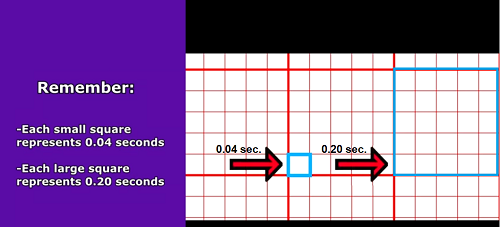
Anytime you analyze a rhythm you want to always ask yourself the following questions and based on the answer to those questions you can identify the rhythm.
ECG/EKG Study Guide and Workbook for Nursing Students

“ECG/EKG Interpretation Study Guide and Workbook by Nurse Sarah”. This book contain 100 pages of content featuring 26 ECG rhythm break downs, 51 ECG rhythm analysis practice problems, 100 comprehensive ECG practice questions, worksheets, chart summaries, and more.
You can get an eBook version here: “Nurse Sarah ECG Book” or a physical copy here: “ECG/EKG Interpretation Study Guide by Nurse Sarah“.
To help you with those questions remember: PQRST
First, is the P:
P-wave: think of the 3 R’s (Regularity, Rate, Resemblance)
Regularity: are the p-waves occurring at the same regularity as the consecutive p-waves on the strip (this represents ATRIAL)…use a pair calipers to help with this

Atrial rate should be regular to be a normal sinus rhythm and means it is originating in the SA node
Rate: Count the p-waves within that 6 second strip and multiple by 10…this is the atrial rate
ATRIAL RATE should be AROUND 60-100 BPM for normal sinus rhythm
Resemblance: How do they look?
Only one p-wave in front of every QRS complex? Are they all identical in how they are round and pointing up and less than 0.12 seconds…less than 3 squares?
Now the QRS:
QRS complex: 3 R’s (Regularity, Rate, Resemblance)
Regularity: are the QRS complexes occurring at the same regularity as the consecutive QRS complexes on the strip (this represents the VENTRICULAR rate)…use calipers to go from R wave to R wave.

Both the atrial and ventricular rhythm should be regular to be a normal sinus rhythm
Rate: Count QRS complex within that 6 second strip and multiply by 10…this is the ventricular rate
ATRIAL RATE AND VENTRICULAR RATE SHOULD BE THE SAME (AROUND 60-100 BPM) for normal sinus rhythm
Resemblance: How do they look?
A QRS complex is present after each p-wave, no more than 0.12 seconds (less than 3 boxes)..measure at the start of the q wave and end of the s wave
Next, the T-wave:
T-wave: should come after the QRS complex and be round and in the upright position in most leads
PQRST Extra: (intervals and segments)
PR interval: what is its measurement? starts at the beginning of the p wave and extends to the beginning of the QRS complex
0.12-0.20 seconds and the measurement should be uniform throughout the rhythm
ST segment: demonstrate the ventricles are starting to relax.
ST segment: starts at the end of the s-wave and stops at the start of the t-wave, should be flat, no elevation or depression of more than 1 mm
QT interval: starts at the beginning of the QRS complex and ends at the end of the t-wave. Should measure: 0.35-0.44 seconds.
Analyze this Rhythm:
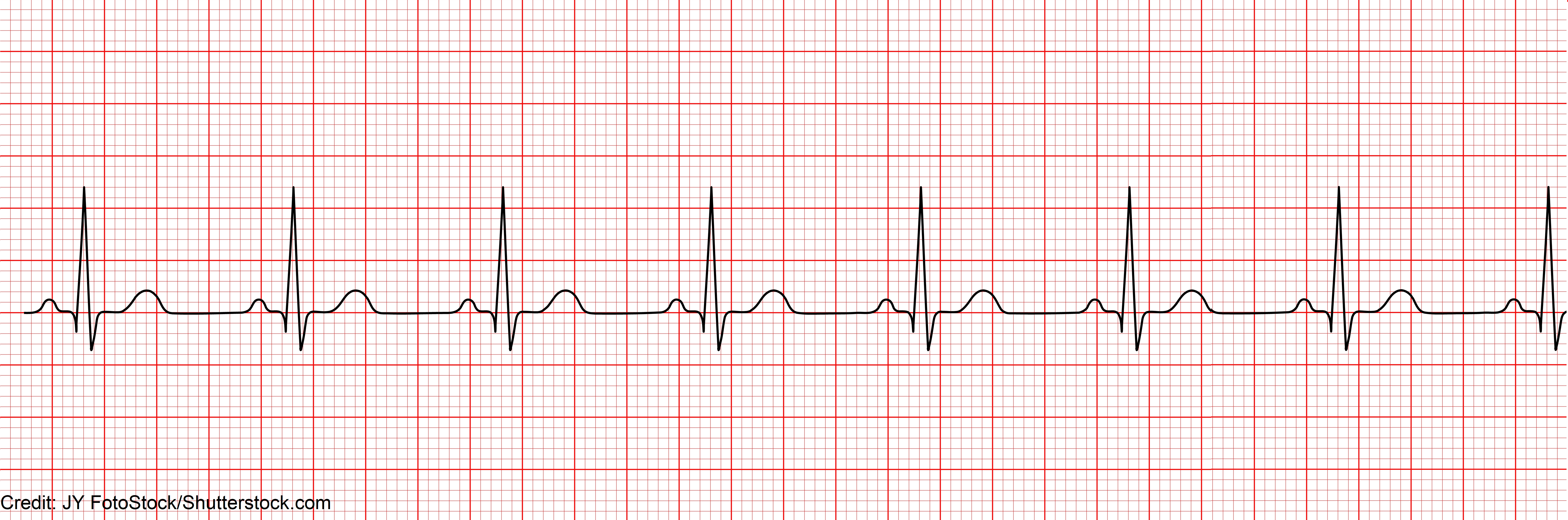
Use the questions above to guide you in analyzing this rhythm:
P-wave:
- Regularity: regular
- Rate: 80 bpm
- Resemblance: yes (p wave measurement: 0.10 seconds)
QRS complex:
- Regularity: regular
- Rate: 80 bpm
- Resemblance: yes (QRS measurement: 0.10 seconds)
T-wave:
- Normal
Extras:
PR Interval: 0.14 seconds
ST segment: flat
QT interval: 0.36 seconds
This is Normal Sinus Rhythm with a rate of 80 bpm.
Now test your knowledge with this ECG Interpretation Quiz.