In this anatomy lesson, you’ll learn that the bones of the hand and wrist make up part of the appendicular skeleton. These bones consist mostly of long bones, except for the eight bones of the wrist, called carpals, which anatomists classify as short bones.
The bones of the hand and wrist can be broken down into 14 phalanges, 5 metacarpals, and 8 carpals. When you combine both hands/wrists, you’ll get a total of 54 bones out of the 206 human bones in the average adult skeleton.
Bones of the Hand: Palm, Fingers, and Wrist (with Mnemonics)
Fingers and Phalanges
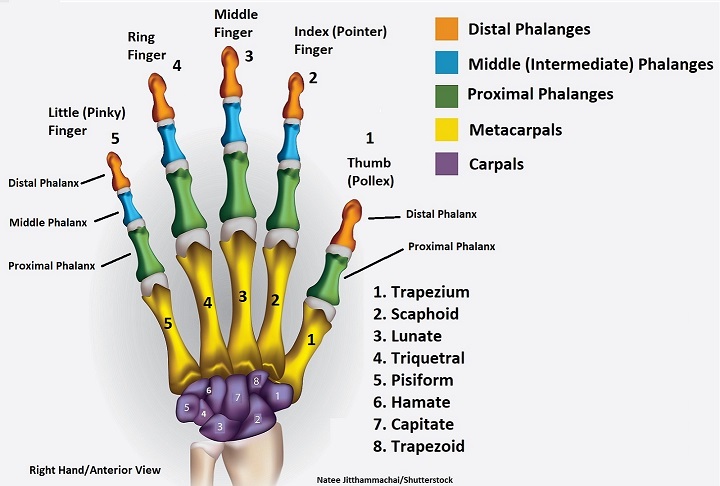
Let’s start with the fingers, which are also called digits. Each digit has a name that you probably already know: You have a thumb (also called pollex), index finger (also called pointer finger), middle finger, ring finger, and little finger (pinky).
These digits, along with the metacarpals, are also numbered one through five, and here’s an easy way to remember the number of each digit: When you give someone a thumbs up, you’re holding up one digit, which also happens to be digit number one! The index finger is digit two, the middle finger is digit three, ringer finger is four, and the little finger is five.
Each finger is made up of three long bones called phalanges, expect for the thumb, which has only two phalanges. (Your toe bones are also called phalanges.)
The phalanges are named after directional terms. If you think back to my video on the directional terms, you’ll remember that distal means further away from the attachment point or origin of a structure, and proximal means closer to the attachment point or origin of a structure (ie, if you make a pistol with your hand, the pistol is distal to the upper arm).
The phalanx (singular form of phalanges) furthest away from the metacarpals is called distal, and the one closest to the metacarpal is called proximal. The phalanx bone in the middle is called “middle” or “intermediate.” The thumb has only distal and proximal phalanges (no middle/intermediate).
Metacarpals
The metacarpus (palm) contains long bones called metacarpals. Let the name help you: The prefix “meta” means beyond, and the word “carpal” comes from Greek and Latin words that mean wrist. So the metacarpals are the bones just beyond the wrist.
These bones don’t have individual names, but rather, are numbered 1-5, with one being the metacarpal proximal to the thumb, and five being the metacarpal proximal to the little finger. (Remember: when you hold up your thumb, it’s one digit, and it’s also digit/metacarpal number one.)
Each metacarpal has a base, which articulates with the carpals, a shaft (or body), and a head, which articulates with the phalanges. The phalanges also have a head, shaft, and base.
By the way, people will often confuse the carpals/metacarpals of the hand with the tarsals and metatarsals of the foot. Here’s a memory trick to avoid confusion: you use your carpals to steer a car, and your tarsals are near your toes.
Carpals
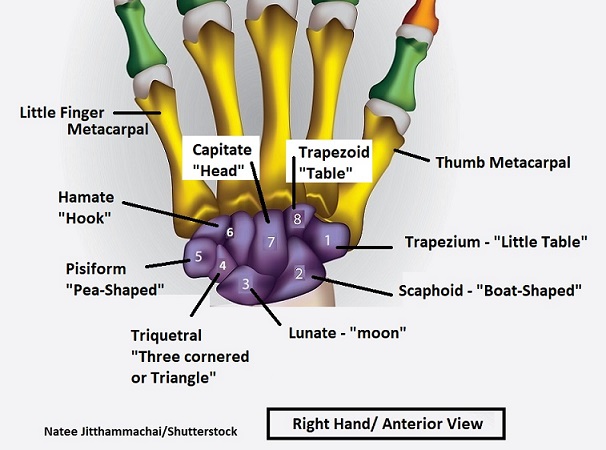
The carpus, or wrist, contains eight short wrist bones are called carpals (named after Latin and Greek words meaning “wrist”). These bones have bizarre names, but that’s because they are named after ancient words related to their general shape:
- Trapezium – “little table”
- Scaphoid – “boat-shaped”
- Lunate – “moon” (think lunar)
- Triquetral – “three cornered” or “triangle”
- Pisiform – “pea-shaped”
- Hamate – “hook”
- Capitate – “head” (think “decapitated,” which means losing your head)
- Trapezoid – “table” or “four -sided”
Carpals (Wrist Bones) Mnemonic
The easiest way to remember the location of the carpals is to use a mnemonic (a memory trick). If you look at the right hand from the anterior position (palm facing you), you’ll notice that the metacarpal of the thumb articulates with the trapezium bone. Thumb and trapezium both start with “t”, and both contain the letter “m.” So that can help you remember which carpal bone articulates with the metacarpal number one (thumb).
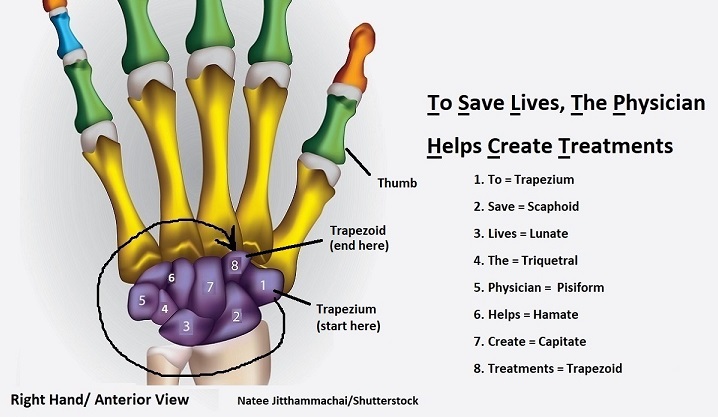
Start with the trapezium bone, and go in a clockwise direction using the following mnemonic: To Save Lives, The Physician Helps Create Treatments.
- To = Trapezium
- Save = Scaphoid
- Lives = Lunate
- The = Triquetral
- Physician = Pisiform
- Helps = Hamate
- Create = Capitate
- Treatments = Trapezoid
Thus, if you are looking at an anterior view of the right hand, you begin with the trapezium at the thumb’s metacarpal, go in a clockwise direction, and end at the trapezoid with this mnemonic.
However, always make sure you know which way your viewing the hand. If the left hand bones were being viewed from the anterior view, you’d go counterclockwise for this mnemonic. You’ll always start with the trapezium bone and move to the bone just below it (scaphoid).
Free Quiz and More Anatomy Videos
Ready to test your knowledge? Take our free (and quick!) hand and wrist bones quiz. Also, you might want to watch more of our anatomy and physiology lectures on YouTube, or check our anatomy and physiology notes.