Learn how to crush medications for feeding tube or oral administration as a nurse.
Why do we crush medications? If a patient has a feeding tube or can’t swallow medications whole due to swallowing difficulties, we must crush the medication.
When crushing medications it is important to perform this skill correctly so the correct dose is administered. In addition, the nurse be aware that not all medications can be crushed.
This article will address the following:
- Steps on how to crush a pill for a feeding tube or oral administration
- Drug categories that cannot be crushed along with a mnemonic to help you remember them
- Tips on how to crush medications
Video Demonstration on How to Crush Medications
Steps on How to Crush a Pill
- Perform hand hygiene and gather supplies
- Tubing Feeding: Enteral 60 cc syringe, pill crusher, room temperature water…amounts vary depending on how many pills you will be giving (check with your hospital protocol for flushing guidelines), medication cup, gloves, medication
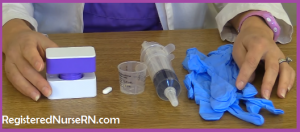
- Orally: apple sauce or water, pill crusher, spoon, medication cup, gloves, medication
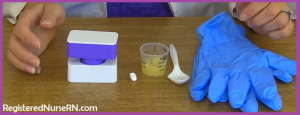 2. Confirm the patient’s 5 medication administration rights: right patient, right dose, right time, right route, and right medication
3. Confirm that medication can be crushed (NOTE: not all medications can be crushed…see details below)
4. Don gloves to protect you for becoming contaminated with medication’s powder. Some medications are toxic.
5. Place a pill in pill crusher. Always use a device that is made to crush pills and crush pills individually…never crush a bunch of pills together. Most facilities have closed pill crushers that are easy to clean and allow you to crush multiple pills without mixing them. So, always be familiar with how to use your facilities device.
- Many medications are not compatible after you crush the protective coating surrounding the material. This causes the active chemicals to mix which can decrease the effectiveness of the medication. In addition, when administering crushed medication through a feeding tube, pills must be given one at a time to prevent clogging the tube. ALWAYS follow your hospital’s protocol for crushing medications.
Tube Feeding: Mix the finely crushed powder of the pill in 20 cc of room temperature water (works best in you mix in a medication cup). Use a 60 cc enteral syringe to draw up the medication. Follow your hospital’s protocol for flushing before, during, and after administration of the medication.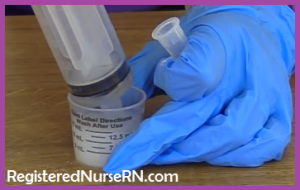
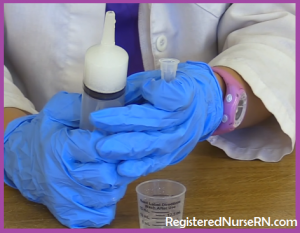
- Orally: Mix the finely crushed powder in apple sauce or water, depending on the patient’s preference. Most patients prefer apple sauce because it slightly decreases the bitter taste of the medication compared to water. If using apple sauce, give a spoonful of apple sauce with each crushed pill. Avoid mixing one pill in a whole container of apple sauce because this is a lot of apple sauce to feed a patient for one pill, especially if they are taking more than one pill.
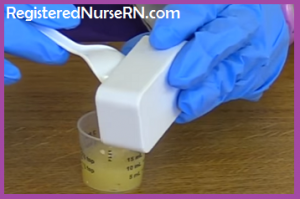
6. Clean the pill crusher.
Tips on Crushing Medications
- Not all medications can be crushed! Always consult with pharmacy if you are not 100% sure if a medication can be crushed. Also, look at the name of the drug for certain letters. For example, Detrol LA or Toprol XL are both long-acting medications that can’t be crushed:
These are the general categories of drugs that cannot be crushed:
- Enteric coated (EC)
- Long acting (LA. XL)
- Extended release (ER, XR)
- Controlled release/delivery (CR, CD)
- Sustained release/action (SR, SA)
Mnemonic:
Seniors erroneously crush enteric-coated laxatives
Seniors: abbreviation for the seniors is: SR (sustained released)
Erroneously: ER (extended release)
Crush: CR (controlled release)
Enteric-coated: EC
Laxatives: LA (long acting)
- If possible, consult with the physician or pharmacists on switching medications to liquid form or IV form. However, liquid form may not be an option for people who need honey or nectar thick liquids for swallowing difficulties.
- Don’t crush all the patient’s medications at the same time and mix them ALL in applesauce/water or in a enteral syringe with water…do this individually.
- Always assess swallowing status before administering oral medications, and placement of feeding tube per hospital protocol.
You may be interested in more nursing skills.
References
- Guidance for Medication Assessment in Patients with Swallowing (Dysphagia) or Feeding Disorders. (2006). U.S. Department of Veterans Affairs. (1st ed., p. 3). Retrieved from https://www.pbm.va.gov/clinicalguidance/clinicalrecommendations/DysphagiaRecommendationsforMedicationAssessment.pdf