As a nurse you want to be familiar with different types of heart rhythms, especially life-threatening rhythms like asystole.
Before reviewing these notes, don’t forget to check out the lecture on asystole.
The “a” in asystole means without, and “systole” means contraction. So, when you put those two words together, you get “without contraction.” And that is exactly what this rhythm is, it means there is no heart contraction. In other words, the heart is just sitting in the chest not pumping (doing something a heart should never do).
Characteristics and Criteria of Asystole
This is one of the easiest rhythms to identify because it presents as a flat line on the ECG. There is no ECG waveform as with the other rhythms. The P wave, QRS complex, and T wave are completely absent. Again, this is occurring because there is no activity from the atria or ventricles being transmitted to the monitor. This means the heart is not pumping.

Now, as a side note, if you see asystole on the monitor always check the patient to confirm the findings (as with other rhythms). This is because if the monitor is not connected properly or some of the electrodes have a bad connection it can present as asystole on the monitor and not truly be asystole.
ECG/EKG Study Guide and Workbook for Nursing Students
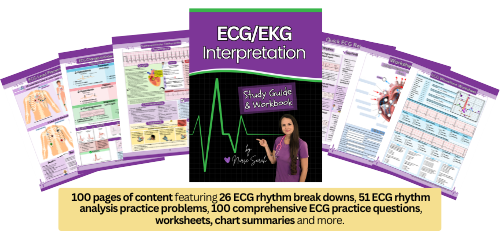
“ECG/EKG Interpretation Study Guide and Workbook by Nurse Sarah”. This book contain 100 pages of content featuring 26 ECG rhythm break downs, 51 ECG rhythm analysis practice problems, 100 comprehensive ECG practice questions, worksheets, chart summaries, and more.
You can get an eBook version here: “Nurse Sarah ECG Book” or a physical copy here: “ECG/EKG Interpretation Study Guide by Nurse Sarah“.
Causes of Asystole
Any of the causes we discussed in the previous rhythms can cause asystole. Asystole is a very bad sign and presents when something fatal has occurred. Many times the patient was in another type of lethal rhythm like ventricular tachycardia (V-tach) or ventricular fibrillation (V-fib) that went untreated and it progressed to asystole.
Therefore, when you are trying to think of the causes of this rhythm think of the H’s and T’s taught in ACLS like: hypovolemia, hypoxia, toxins, thrombosis and so forth.
Treatment of Asystole
When you confirm the patient is in asystole, get help by activating emergency response system (call a code blue etc.) and start CPR. When help arrives follow ACLS algorithm recommendations.
This includes rhythm checks. It’s important to note that asystole is a non-shockable rhythm. Therefore, it can’t be defibrillated. Medications that can be administered are Epinephrine. Other treatment includes supporting the airway.
As the patient is resuscitated it’s important to think of a potential cause of the rhythm. Again, think of the H’s and T’s.
Now test your knowledge on this material with this free asystole ECG quiz.
References:
American Heart Association | Algorithms. (n.d.). Retrieved September 2, 2022, from https://cpr.heart.org/en/resuscitation-science/cpr-and-ecc-guidelines/algorithms#adult