This review will cover the different types of adventitious (abnormal) lung sounds. As a nurse you want to be able to identify abnormal lung sounds and their characteristics.
In this review you will learn about: wheezes, coarse crackles, fine crackles, stridor, pleural friction rub, rhonchi.
What questions should you be asking yourself while auscultating adventitious lung sounds?
When you’re auscultating lungs sounds you want to tune your ears to take notice of the following things that will help you determine what type of abnormal sound you are hearing:
- Timing: are you hearing it mainly on inspiration or expiration or even both?
- Pitch: low or high pitch?
- Discontinuous or continuous? meaning are you able to distinguish the individual sounds that come in a series and are intermittent (discontinuous)? Or are they a continuous sound?
- Location? large airways (upper respiratory, trachea, large bronchi) vs. small airways (lower parts of the respiratory like the bronchioles or alveoli)
- Does it have defining auditory characteristics that are hard to ignore? for example, harsh-grating, squeaky musical whistling, snoring, or squawking etc.
Rhonchi
Timing: Occurs mainly on expiration but could be heard along with inspiration
Pitch: Low-pitched and loud
Continuous
Location: large airways like trachea and bronchus
Defining characteristics: snoring or snorting sounds that will decrease or go away with coughing or suctioning
Listen to an Example of Rhonchi
Causes of Rhonchi
This sound occurs as air leaves the trachea and bronchus and hits secretions like mucus and fluid, creating a snoring like sound.
Conditions that can cause this are like bronchitis, pneumonia, and COPD.
As a side note: Some literature sources will call rhonchi a type of coarse crackle or wheeze known as a sonorous wheeze. Therefore, as you study keep this in mind and go by how your professor or facility categorizes rhonchi.
Wheezes (High-Pitched)
Timing: Occurs mainly on expiration where it is the loudest, but can also be noted on inspiration and expiration
Pitch: high-pitched
Continuous
Location: throughout various parts of the respiratory system
Defining characteristics: squeaky, musical whistling that can sometimes even be heard without a stethoscope like in cases of an asthma attack, but the sound isn’t mainly auscultated from the throat area (this is associated with stridor).
Listen to an Example of Wheezing
Causes of Wheezes?
This sound is occurring because airways have narrowed. Therefore, when air is trying to go through these narrowed airways it creates a squeaky musical sound.
It can occur with asthma, COPD, and lung infections that cause swelling of the airways like with viral respiratory infections.
Stridor
Timing: inspiratory or expiratory
Pitch: high-pitched
Continuous
Location: upper respiratory system
Defining characteristics: screeching/squawking noise from the throat area
Listen to an Example of Stridor
Causes of Stridor?
This sound can be life-threatening and require immediate treatment depending on the severity of the stridor and its cause.
Stridor is occurring because there is narrowing of the larynx and trachea due to swelling from an infection, blockage from an object etc. In the end, it can lead to a completely blocked airway.
For example, stridor can be heard in cases of epiglottis or croup (you may hear it described as a “barking” cough) that affects the pediatric population.

The epiglottis is a structure found in the throat in front of the larynx. This structure can become inflamed due to bacterial infections like Haemophilus influenzae type B, or in cases of anaphylaxis and from a foreign object blocking the airway.
Pleural Friction Rub
Timing: inspiration and expiration
Pitch: low-pitched
Discontinuous or continuous depending the cause and severity
Location: pleural layers
Defining characteristics: harsh-grating noise and pain reported by the patient with coughing, deep breathing, laughing etc.
Listen to a Pleural Friction Rub
Causes of Pleural Friction Rubs?
This sound occurs when the pleural layers become inflamed and rub against one another.
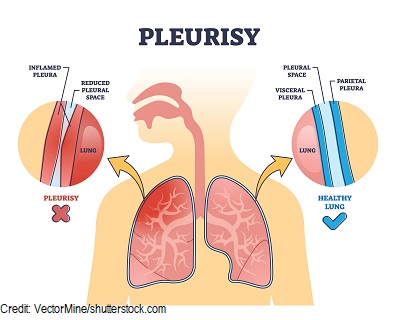
These layers are the visceral and parietal pleura, which should normally glide over one another with breathing. However, the space that separates the layers shrinks from inflammation and results in a harsh-grating noise.
It can happen in causes of pleurisy “pleuritic”, pneumonia, tuberculosis, pulmonary embolism, and some forms of lung cancer.
Coarse Crackles
Timing: Occurs around the beginning of inspiration and can extend into expiration and are longer than fine crackles
Pitch: Low-pitched and louder than fine crackles
Discontinuous
Location: large airways like the bronchi
Defining characteristics: gurgling or bubbling sounds that does not go away with coughing
Listen to Coarse Crackles
Causes of Coarse Crackles?
This sound tends to occur because air the patient breathes in hits partially blocked airways (like in the large bronchi) that are blocked with fluid or thick mucus.
So, think of lungs conditions that present with fluid and/or mucus:
- heart failure due to pulmonary edema (fluid in the lungs)
- severe cases of pneumonia
- bronchiectasis (a chronic lung condition where the bronchi are enlarged due to chronic lung disease (cystic fibrosis)
- infections that results in moderate to severe mucus secretions
Fine Crackles Description
Timing: Occurs toward the end of inspiration and is brief (short)
Pitch: High-pitched
Discontinuous
Location: Small airways
Defining characteristics: the light crackling or popping of a fire and it doesn’t go away with coughing
Listen to Fine Crackles
Causes of Fine Crackles?
This sound is usually occurring because when the patient inhales air into the small airways (like the bronchioles and alveoli, which are deflated or collapsed) it leads these structures to all of a sudden “crackle” or “explode” open, which creates this high-pitched crackling noise that is brief.
It can occur with cases of congestive heart failure, atelectasis, pulmonary fibrosis, and pneumonia.
Test your knowledge on abnormal respiratory sounds.
Nurse Sarah’s Notes and Merch
Just released is “ABG Interpretation Notes, Mnemonics, and Workbook by Nurse Sarah“. These notes contain 64 pages of Nurse Sarah’s illustrated, fun notes with mnemonics, and worksheets that include over 90 ABG practice problems and 60 test review questions covering ABG concepts.
You can get an Nurse Sarah’s digital notes or a physical copy of the book here.

References:
Adderley N, Sharma S. Pleural Friction Rub. [Updated 2022 Sep 13]. In: StatPearls [Internet]. Treasure Island (FL): StatPearls Publishing; 2022 Jan-. Available from: https://www.ncbi.nlm.nih.gov/books/NBK537118/
Centers for Disease Control and Prevention. (2021, August 18). Pinkbook: Haemophilus influenzae (Hib). Centers for Disease Control and Prevention. Retrieved from https://www.cdc.gov/vaccines/pubs/pinkbook/hib.html
Centers for Disease Control and Prevention. (2023, February 28). Asthma. Centers for Disease Control and Prevention. Retrieved March 2, 2023, from https://www.cdc.gov/asthma/default.htm
Kataoka H, Matsuno O. Age-related pulmonary crackles (rales) in asymptomatic cardiovascular patients. Ann Fam Med. 2008 May-Jun;6(3):239-45. doi: 10.1370/afm.834. PMID: 18474887; PMCID: PMC2384982.
Kim, Y., Hyon, Y., Jung, S. S., Lee, S., Yoo, G., Chung, C., & Ha, T. (2021). Respiratory sound classification for crackles, wheezes, and rhonchi in the clinical field using deep learning. Scientific reports, 11(1), 17186. https://doi.org/10.1038/s41598-021-96724-78.
U.S. Department of Health and Human Services. (n.d.). Bronchitis. National Heart Lung and Blood Institute. Retrieved from https://www.nhlbi.nih.gov/health/bronchitis
Zimmerman B, Williams D. Lung Sounds. [Updated 2022 Aug 29]. In: StatPearls [Internet]. Treasure Island (FL): StatPearls Publishing; 2022 Jan-. Available from: https://www.ncbi.nlm.nih.gov/books/NBK537253/