This NCLEX review will discuss nursing t-tube care.
As a nursing student or nurse, you must be familiar with t-tube care. This review will give you an easy to remember mnemonic to help you remember those important concepts for exams and explain what a t-tube is, where it’s located, and why they are used.
Lecture on T-Tube Nursing Care
 T-Tube Nursing Care NCLEX Review
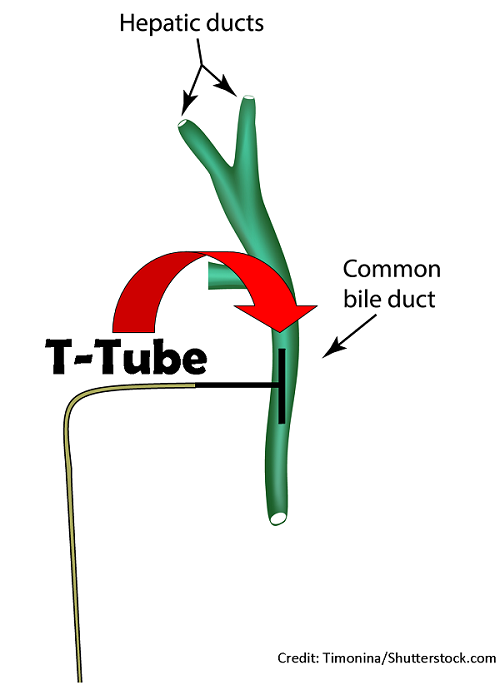
What’s a T-Tube? It’s a t-shaped tube that is placed in the bile duct to help drain excessive bile and can be used for testing to assess the biliary tree and ducts.
What would a patient have a t-tube?
- Cholecystectomy: It’s sometimes placed after the removal of the gallbladder. A cholecystectomy may need to be performed because the gallbladder is inflamed (cholecystitis) or there are gallstones (which leads to gallbladder inflammation).
- Common bile duct exploration: This is where an incision is made in the bile duct to assess the duct…sometimes gallstones may become lodged within this network of ducts. It may be performed during a cholecystectomy, especially if gallstones were the cause for the removal of the gallbladder. A t-tube will be placed to help out the duct as it heals and swelling decreases, and then it will be removed.
- Liver transplant
Role of the t-tube? It will serve as a drain that will drain off excessive bile and will be removed once healing has taken place. It can also be used for testing where dye is injected into the t-tube and x-ray imaging is taken (cholangiogram) to assess the biliary tree and duct like the picture below.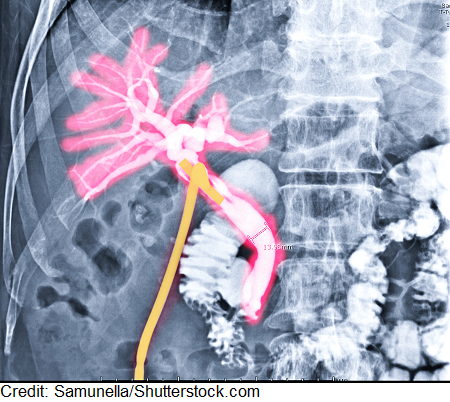
Now, let’s talk about nursing care and those main concepts you need to know for exams about t-tubes.
Nursing Care of T-Tubes
“Drain”
Drainage bag positioned correctly
- WHY? The collection bag drains bile with the help of gravity.
- Keep tubing untangled/kink-free and keep the tubing/drainage bag below the site of insertion (needs to be at or below the waist level).
- To help facilitate drainage keep patient is Semi-Fowler’s position…30-45 degree angle.
- Prevent dislodgement! Teach patient how to prevent pulling drain out by never putting tension on the tubing (example: avoid sleeping on it, keep it secured while ambulating or moving).
Record and empty drainage per facility’s protocol
- WHY? This helps make sure the t-tube is draining because they can become blocked, leak bile into the abdominal cavity (leading to peritonitis), or there is excessive drainage (bleeding etc.).
- Fresh post-op (1-2 days): drainage starts out with some blood and then progresses to a greenish/yellow/brown liquid drainage.
- Drainage should NOT be more than 500 mL/day (notify MD if this happens)…the drainage will decrease as the patient recovers.
Assess color and consistency of drainage
- Document…color should be yellowish greenish/brownish
- watch for extremely thick, bad smelling drainage with a fever or extremely bloody like bright red blood that looks fresh)
Inspect skin and abdomen frequently
- Change dressing (keep it dry and clean)…bile is very harsh on the skin
- Monitor for bile leakage into abdomen (bile peritonitis)
- bloating, abdominal pain (especially with palpated), n/v, diarrhea, fever
Need physician’s order to clamp or flush the t-tube
- Flush to maintain patency with a standing doctor’s order
- The doctor may order the t-tube to be clamped at times so bile can drain to the duodenum so fats can be digested during meal times…follow MD’s specific orders. Example: Clamp 1 hour before and 1 hour after meals.
- Assess how well patient tolerated the t-tube being clamped…if patient develops abdominal pain, nausea vomiting etc. unclamp it and notify MD.
- Clamping the t-tube tell us how well the bile duct is working to deliver the bile and if the patient will be able to tolerate not having the t-tube once it’s removed.
Now test your knowledge with this t-tube nursing quiz.