Pleural friction rub, also known as pleural rub, is an abnormal lung sound that presents with a harsh-grating noise. It occurs during inspiration and expiration.
However, before we jump right into identifying a pleural friction rub, let’s go over the basics in helping you understand how to identify adventitious lung sounds.
What questions should you be asking yourself while auscultating adventitious lung sounds?
When you’re auscultating lungs sounds you want to tune your ears to take notice of the following things that will help you determine what type of abnormal sound you are hearing:
- Timing: are you hearing it mainly on inspiration or expiration or even both?
- Pitch: low or high pitch?
- Discontinuous or continuous? meaning are you able to distinguish the individual sounds that come in a series and are intermittent (discontinuous)? Or are they a continuous sound?
- Location? large airways (upper respiratory, trachea, large bronchi) vs. small airways (lower parts of the respiratory like the bronchioles or alveoli)
- Does it have defining auditory characteristics that are hard to ignore? for example, harsh-grating, squeaky musical whistling, snoring, or squawking etc.
Pleural Friction Rub Description
Timing: inspiration and expiration
Pitch: low-pitched
Discontinuous or continuous depending the cause and severity
Location: pleural layers
Defining characteristics: harsh-grating noise and pain reported by the patient with coughing, deep breathing, laughing etc.
Listen to a Pleural Friction Rub
Causes of Pleural Friction Rubs?
This sound occurs when the pleural layers become inflamed and rub against one another.
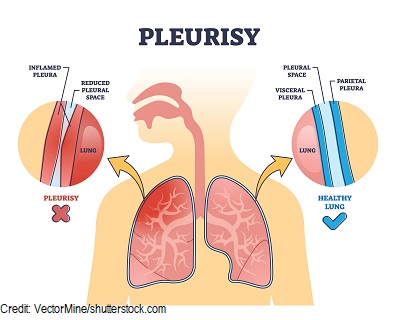
These layers are the visceral and parietal pleura, which should normally glide over one another with breathing. However, the space that separates the layers shrinks from inflammation and results in a harsh-grating noise.
It can happen in causes of pleurisy “pleuritic”, pneumonia, tuberculosis, pulmonary embolism, and some forms of lung cancer.
Now test your knowledge with this pleural friction rub quiz.
Nurse Sarah’s Notes and Merch
Just released is “ABG Interpretation Notes, Mnemonics, and Workbook by Nurse Sarah“. These notes contain 64 pages of Nurse Sarah’s illustrated, fun notes with mnemonics, and worksheets that include over 90 ABG practice problems and 60 test review questions covering ABG concepts.
You can get an eBook version of Nurse Sarah’s notes or a physical copy of the book here.
References:
Adderley N, Sharma S. Pleural Friction Rub. [Updated 2022 Sep 13]. In: StatPearls [Internet]. Treasure Island (FL): StatPearls Publishing; 2022 Jan-. Available from: https://www.ncbi.nlm.nih.gov/books/NBK537118/
Zimmerman B, Williams D. Lung Sounds. [Updated 2022 Aug 29]. In: StatPearls [Internet]. Treasure Island (FL): StatPearls Publishing; 2022 Jan-. Available from: https://www.ncbi.nlm.nih.gov/books/NBK53