This fetal heart rate monitoring practice quiz will help you learn how to differentiate between fetal accelerations, early decelerations, late decelerations, and variable decelerations.
On the NCLEX exam and in your maternity OB nursing lecture classes, you will have to know how to identify each fetal heart rate tone deceleration.
Furthermore, you will need to know what causes these decelerations to happen and if you need to intervene as the nurse.
Nurse Sarah explains in this video tutorial some clever ways on how to learn these type of fetal heart rate decelerations. In addition, she explains how to identify each decelerations which makes learning this material very easy to remember.
Video on Fetal Heart Rate Decelerations
Fetal Heart Rate Monitoring Practice Quiz (Early, Late, Variable, Accelerations)
This fetal heart rate monitoring practice quiz will test your knowledge about fetal decelerations and accelerations during labor. You must know how to identify accelerations, early decelerations, late decelerations, and variable decelerations. In addition, you must know what is causing each type of deceleration, such as uteroplacental insufficiency or umbilical cord compression.
Maternity Nursing Study Guide

Save Time Studying and Actually Learn
Nurse Sarah’s Maternity Nursing Study Notes are designed to help you study faster, remember more, and stress less. With 151 pages of simplified summaries, illustrations, mnemonics, and visual breakdowns, you’ll breeze through even the trickiest OB topics.
Laser-Focused on What You’ll See on Exams
Whether you’re prepping for nursing school exams or the NCLEX®, these notes focus on the exact maternity/OB concepts you’re most likely to be tested on with no filler, no wasted time.
Memory Hacks, Visuals & Rationales That Make It Stick
Colorful illustrations and proven mnemonics help you actually retain the material, while 220 practice questions with in-depth rationales teach you the “why” behind the right answers so that you’re not just memorizing, you’re understanding.
Available at: NurseSarah.com and Amazon.com* (This is an affiliate link. We may earn a small commission if you make a purchase through this link at no extra cost to you).
Fetal Heart Rate Monitoring Practice Quiz
- True or False: A normal fetal heart rate is between 100-120 bpm.
True
False
The answer is FALSE. A normal fetal heart rate is between 110-160 bpm. A rate of 100-120 would be too slow and could indicate bradycardia.
- On the fetal heart monitor, you see early decelerations. What is the most likely cause?
A. Compression of the fetal head
B. Uteroplacental insufficiency
C. Umbilical cord compression
D. Prolapsed uterus
The answer is A: compression of the fetal head. Early decelerations are gradual and mirror maternal contractions. They are benign and due to fetal head compression. The compression of the head stimulates the vagus nerves and temporarily slows the fetal heart rate.
- The illustration below demonstrates why type of fetal heart tracing?
A. early decelerations
B. accelerations
C. variable decelerations
D. late decelerations

The answer is C: variable decelerations. These type of decelerations are abrupt decreases in fetal heart rate that vary in timing, shape, and duration. They are usually caused by umbilical cord compression. The FHR often drops suddenly and may return to baseline quickly, sometimes forming a “V,” “U,” or “W” shape on the monitor.
- Based on the fetal heart rate pattern identified in Question 3, which nursing intervention is most appropriate?
A. start oxytocin drip per protocol
B. place the patient in knee-to-chest position
C. administer 1-2 liters of oxygen via cannula
D. no interventions are needed at this time; continue to monitor
The answer is B: place the patient in knee-to-chest position. The answer to Question 3 was variable decelerations. These decelerations are caused by umbilical cord compression. The first-line intervention is to change the patient’s position (knee-to-chest or side-lying) to relieve pressure on the cord and improve fetal oxygenation. Oxygen can be given along with positioning at 8–10 L/min via non-rebreather mask. Other options are inappropriate: oxytocin could worsen decelerations, and just monitoring delays necessary intervention.
- The nurse notes the fetal heart tracing below and knows that the most likely cause is?
A. umbilical cord compression
B. uterine atony
C. fetal head compression
D. uteroplacental insufficiency
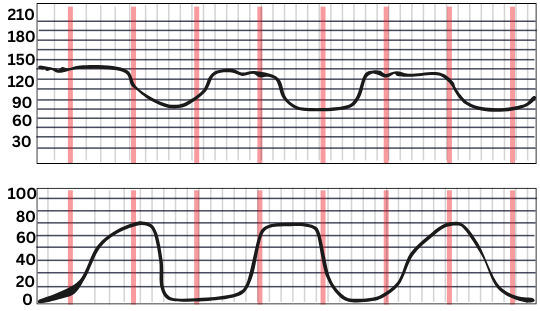
The answer is D: uteroplacental insufficiency. Noted below are late decelerations. These decelerations are gradual decreases in fetal heart rate that begin after a contraction starts and return to baseline after it ends. They indicate impaired blood flow and oxygen delivery from the placenta and are considered non-reassuring, requiring prompt nursing interventions to improve fetal oxygenation.
- The illustration below demonstrates why type of fetal heart tracing?
A. early decelerations
B. late decelerations
C. variable decelerations
D. accelerations
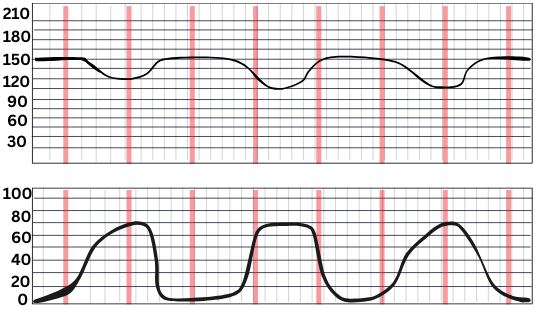
The answer is A: early decelerations. Early decelerations are gradual decreases in fetal heart rate that mirror uterine contractions, beginning and ending with the contraction. They are usually caused by fetal head compression during labor, stimulating the vagus nerve. This pattern is considered benign and reassuring, and usually don’t require intervention.
- The nurse is assessing the fetal heart tracing along with the maternal contractions. It is noted that the fetal heart rate drops after the peak of the maternal contraction and does not recover until well after the contraction ends. Which option below would the nurse NOT implement based on this finding?
A. change maternal position to Trendelenburg
B. notify healthcare provider
C. administer IV fluid bolus
D. prep patient for a possible c-section
The answer is A: change maternal position to Trendelenburg. The fetal heart rate pattern described is late decelerations, which indicate uteroplacental insufficiency and fetal hypoxia. Nursing interventions: notifying the healthcare provider, giving an IV fluid bolus, and preparing for a possible cesarean if the pattern persists. For fetal heart rate decelerations, recent evidence shows that routine high-flow oxygen is no longer recommended unless the mother is hypoxic. First-line interventions remain maternal repositioning, IV fluids, and stopping uterotonics. Trendelenburg position is not recommended, as it does not reliably improve uteroplacental blood flow.
- What is the most appropriate nursing intervention based on the fetal heart monitoring noted below?
A. continue to monitor
B. change maternal position to knee-to-chest position
C. perform a vaginal exam
D. administer 8-10 L oxygen via mask

The answer is A: continue to monitor. The fetal heart tracing shows accelerations, which are abrupt increases in fetal heart rate associated with fetal movement or stimulation. This pattern is reassuring and indicates adequate oxygenation and a healthy, responsive fetus. No interventions are needed other than ongoing observation and routine monitoring.
- The nurse observes variable decelerations on the fetal heart monitor. These are most likely caused by which of the following?
A. umbilical cord compression
B. uteroplacental insufficiency
C. head compression
D. contractions
The answer is A: umbilical cord compression. Variable decelerations are abrupt decreases in fetal heart rate that vary in timing, shape, and duration. They are most commonly caused by umbilical cord compression, which temporarily reduces blood flow and oxygen to the fetus. This pattern is different from early decelerations (caused by head compression) and late decelerations (caused by uteroplacental insufficiency) and may occur with or without contractions.
- A patient at 38 weeks gestation has accelerations noted on the fetal heart monitor. Which of the following criteria best defines this finding?
A. A sudden increase of at least 5 bpm above baseline for 15 seconds to 2 minutes
B. An abrupt decrease of at least 15 bpm below baseline lasting more than 15 seconds
C. A sudden increase of at least 15 bpm above baseline for 15 seconds to less than 2 minutes
D. None of the above
The answer is C: a sudden increase of at least 15 bpm above baseline for 15 seconds to less than 2 minutes Accelerations are abrupt increases in fetal heart rate above baseline, typically ≥15 bpm for ≥15 seconds but less than 2 minutes in a term fetus. They are a reassuring sign, indicating adequate fetal oxygenation and a healthy, responsive fetus.
*Disclaimer: While we do our best to provide students with accurate and in-depth study quizzes, this quiz/test is for educational and entertainment purposes only. Please refer to the latest NCLEX review books for the latest updates in nursing. This quiz is copyright RegisteredNurseRn.com. Please do not copy this quiz directly to other websites or file sharing platforms.