Registered Nurse RN

Registered Nurse, Free Care Plans, Free NCLEX Review, Nurse Salary, and much more. Join the nursing revolution.

  • RN
    • Nursing Clinical Skills
  • Nursing Videos
  • Blog
  • Nursing School
  • Nursing Care Plans
  • Nursing Quizzes
  • Nursing
  • Nursing Jobs
  • NCLEX Review
  • Store

ECG/EKG Practice Quiz (Identify Rhythms)

This ECG practice quiz is comprehensive and will test your knowledge on how to identify rhythms, treatments, and the nurse’s role.

Don’t forget to check out our complete ECG series that covers everything you need to know about EKG interpretation as a new nurse, as well as our comprehensive EKG rhythms video.

ECG/EKG Study Guide and Workbook for Nursing Students
ekg ecg interpretation, ecg ekg study guide, nurse sarah, ecg workbook

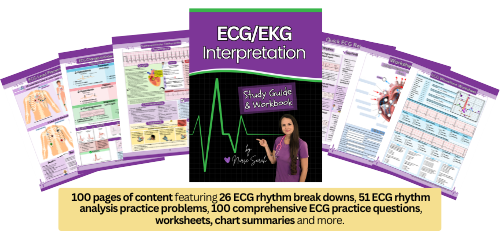
“ECG/EKG Interpretation Study Guide and Workbook by Nurse Sarah”. This book contain 100 pages of content featuring 26 ECG rhythm break downs, 51 ECG rhythm analysis practice problems, 100 comprehensive ECG practice questions, worksheets, chart summaries, and more.

You can get an eBook version here: “Nurse Sarah ECG Book” or a physical copy here: “ECG/EKG Interpretation Study Guide by Nurse Sarah“.

ECG/EKG Practice Quiz (Identify Rhythms)

Normal Sinus Rhythm Quiz ECG
1. Select the options below that best describe the rhythm above:(Required)
Normal Sinus Rhythm Quiz ECG
2. The nurse notes the rhythm above on the cardiac monitor. The nurse does a pulse check and a pulse is present. What next action by the nurse is most appropriate?(Required)
3. You obtain an ECG on a patient and the rhythm is sinus bradycardia with a rate of 52 bpm. Your NEXT nursing action is to?(Required)
ECG Practice Test
4. What is the rate of the rhythm above?(Required)
5. You're analyzing an ECG strip. In order for the rhythm to be identified as Sinus Tachycardia, what must be present in the rhythm? (Select all that apply):(Required)
ECG Practice Test
6. True or False: The rhythm above is Sinus Tachycardia.(Required)
Ventricular Tachycardia (Vtach) Quiz ECG
7. The patient is experiencing the rhythm above. The patient is presenting with a blood pressure of 70/42, mental status changes, and is clammy and pale. A pulse is present. The nurse preps the patient for?(Required)
Ventricular Tachycardia (Vtach) Quiz ECG
8. Select the options below that describe the rhythm above:(Required)
Ventricular Fibrillation ECG Quiz
9. The nurse sees the rhythm above on the ECG. The patient is unresponsive and has no pulse. The nurse calls a code blue and takes what step next?(Required)
10. You’re patient is in ventricular fibrillation (v-fib). You’ve started CPR and the airway is supported. A rhythm checked in performed and shows the patient is still in ventricular fibrillation. The NEXT action the code team will take in addition to performing high-quality CPR is to?(Required)
11. A hallmark finding in a First-Degree Heart Block is?
12. What medication below could cause a First-Degree Heart Block?(Required)
First-Degree AV Heart Block

Second Degree Type I Heart Block Mobitz I Wenckebach
13. Which rhythm above illustrates a Second-Degree type I (Mobitz I or Wenckebach) heart block?
14. True or False: A hallmark finding in a Second-Degree type I (Mobitz I or Wenckebach) heart block is that the PR interval will remain constant throughout the rhythm but there will be a dropped QRS complex after a p wave.(Required)
Heart Block Quiz Questions ECG Interpretation
15. Which rhythm above is an ECG reading that represents a Second-Degree Type II Heart Block (Mobitz II)?(Required)
16. Which of the following is NOT a finding in a Second-Degree Type II heart block (Mobitz II) ECG reading?(Required)
Third-Degree Heart Block Quiz ECG
17. Which rhythm above is a Third-Degree Heart Block?(Required)
18. TRUE or FALSE: A Third-Degree Heart Block is unlikely to cause symptoms in a patient and usually requires no treatment.(Required)
Atrial Flutter (A-Flutter) Quiz ECG
19. Fill-in-the-blank: Rhythm 1 is _________________ , and Rhythm 2 is _____________.(Required)
20. Your patient's ECG shows atrial flutter. What complication can arise from this type of rhythm?(Required)
Atrial Fibrillation (A-Fib) Quiz ECG
21. The patient's ECG shows the rhythm above. The patient is symptomatic and experiencing shortness of breath and chest pain. The patient's blood pressure in 80/44 with the heart rate fluctuating between 130-150s. The nurse calls a rapid response and prepares the patient for?(Required)
Atrial Fibrillation (A-Fib) Quiz ECG
22. Which rhythm above is atrial fibrillation?(Required)

Don’t forget to tell your friends about this quiz by sharing it your Facebook, Twitter, and other social media. You can also take more fun nursing quizzes.

*Disclaimer: While we do our best to provide students with accurate and in-depth study quizzes, this quiz/test is for educational and entertainment purposes only. Please refer to the latest NCLEX review books for the latest updates in nursing. This quiz is copyright RegisteredNurseRn.com. Please do not copy this quiz directly; however, please feel free to share a link to this page with students, friends, and others.

Please Share:

  • Print (Opens in new window) Print
  • Share on Facebook (Opens in new window) Facebook
  • Share on X (Opens in new window) X
  • Share on Pinterest (Opens in new window) Pinterest
  • More
  • Share on Reddit (Opens in new window) Reddit
  • Share on LinkedIn (Opens in new window) LinkedIn
  • Share on WhatsApp (Opens in new window) WhatsApp
  • Share on Telegram (Opens in new window) Telegram

Nursing Notes

Nursing School Bundles Notes by Nurse Sarah

RSS Latest YouTube Videos

  • Hepatitis B Vaccine, Symptoms, Treatment Nursing STI NCLEX Review
  • Deep Tendon Reflexes in 8 Seconds #nursing #nurse #nclex
  • HIV Opportunistic Infections Made Easy for Nursing School & NCLEX
  • Nursing Vascular System Medical Terminology to Know #shorts

Recent Posts

  • STI/STD NCLEX Review Questions – COMPREHENSIVE
  • Hepatitis B NCLEX Practice Questions
  • Order of Draw Phlebotomy Quiz Questions
  • Insulin Types Explained: Onset, Peak, Duration (Ultra-Rapid, Rapid, Short, Long-Acting)
  • NCLEX Practice Questions: Infection Control and Safety

Disclosure and Privacy Policy

This website provides entertainment value only, not medical advice or nursing protocols. We strive for 100% accuracy, but nursing procedures and state laws are constantly changing. By accessing any content on this site or its related media channels, you agree never to hold us liable for damages, harm, loss, or misinformation. See our full disclosure and privacy policy.

Important Links

  • Advertise
  • Contact Us

Follow Us on Social Media

  • Facebook Nursing
  • Instagram Nursing
  • TikTok Nurse
  • Twitter Nursing
  • YouTube Nursing

Copyright Notice

All images, articles, text, videos, and other content found on this website are protected by copyright law and are the intellectual property of RegisteredNurseRN.com or their respective owners.

Copyright © 2026 RegisteredNurseRN.com. All Rights Reserved.