Before you take a patient’s blood pressure or perform a clinical skills check-off in nursing school, make sure you aren’t making these common blood pressure mistakes.
Mistake #7: Documenting a Manual Blood Pressure with Odd Numbers
On a typical manual blood pressure gauge, you will see little marks with numbers. The small lines generally represent 2 mmHg, and the larger lines represent 10 mmHg.
For example, if the needle lands on the position pictured below for the systolic, that would be 116 mmHg.
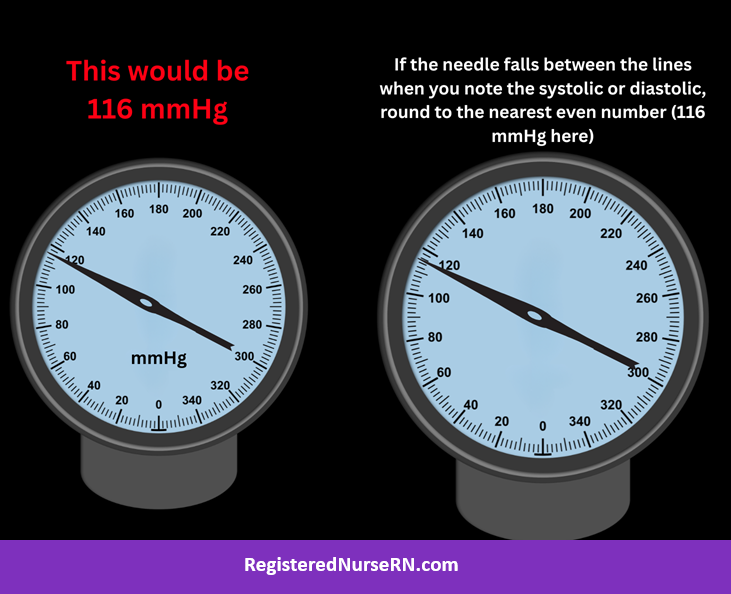
If it seems like the needle falls in between the two lines, round to the nearest line for a manual blood pressure (or follow your facility’s protocols).
Why is this such a big deal? Some nursing schools will take away points on a skills check-off if you record an odd number, and the AHA explicitly states to record the manual BP to the nearest even number.
So you’d generally avoid documenting 131/83 (odd numbers), for example, and instead, you’d round to the nearest even numbers (example: if the needle is closest to 130 and 82, you’d document 130/82).
Note: Automatic blood pressure monitors DO often record in even or odd numbers due to their calibration. Therefore, you don’t want to round those numbers, and instead, report exactly what the display reads.
Mistake #6: Misunderstanding Blood Pressure Stages
Over the years, the guidelines have changed for blood pressure stages. If you see a blood pressure of 120/82, you might think, this blood pressure is normal.
Not quite!
According to the AHA and ACC guidelines, blood pressure is classified by the higher category of either the systolic or diastolic pressure.
A systolic pressure of 120 is actually in the “elevated” range, and a diastolic pressure of 82 falls in the stage 1 hypertension range.
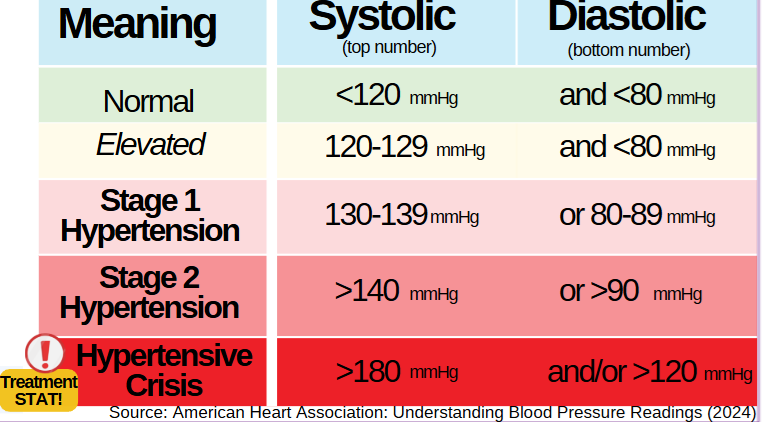
Therefore, a blood pressure of 120/82 is Hypertension Stage 1.
So remember, the diastolic number matters just as much as the systolic number.
Mistake #5: Assuming Elevated Blood Pressure Readings Mean Hypertension
If a patient has one or two elevated readings, it doesn’t automatically mean a patient has hypertension. Factors like white coat hypertension/syndrome, stress, anxiety, or even a full bladder can cause temporary spikes in blood pressure.
Therefore, look at the patient’s blood pressure trend over time, not an isolated reading. It is also a good idea to encourage patients to monitor their blood pressure regularly at home with an automatic blood pressure monitor. They can write down their results at home and present them to their healthcare provider if they do suffer from white coat hypertension/syndrome.
According to the CDC, “As many as 1 in 3 people who have a high blood pressure reading at the doctor’s office may have normal blood pressure readings outside of it.”
Mistake #4: Deflating the Cuff Too Quickly or Too Slowly During a Manual Blood Pressure
Blood pressures are measured in “millimeters of mercury” (mmHg). Ideally, you want the needle/ticker to fall at a speed of about 2-3 mmHg per second.
If it falls faster than that, you could miss some of the Korotkoff sounds, leading to an inaccurate reading. If the needle falls too slowly, it can be uncomfortable for the patient, and the needle can begin bouncing in place, affecting the accuracy of the reading.
Mistake #3: Failing to Properly Prep the Patient
Even seemingly insignificant things can affect the accuracy of a blood pressure reading, so it is important to prepare the patient for the procedure.
For example, you want to place the cuff on the arm according to the manufacturer’s specification, which is usually around 1-2 inches above the arm’s bend (this can vary, so read the machine/cuff’s instructions).
Sizing the cuff properly is also important. If the cuff is too small, the blood pressure may read higher than it should. If it is too large, it could be lower.
Positioning the patient is also important. If the patient crosses the legs or allows the arm to fall below heart level, it could increase the blood pressure reading. Have the patient sit with their back supported, legs uncrossed, and arm at heart level.
For the most accurate reading, make sure the patient avoids eating, drinking, caffeine, smoking, and exercise for at least 30 minutes before the procedure, and ensure the patient doesn’t have a full bladder, as those things can temporarily affect the blood pressure reading. Allowing the patient to rest a few minutes before the procedure (while you focus on collecting other information) can also help get an accurate read on the patient.
Mistake #2: Not Palpating the Systolic Pressure Before a Manual Blood Pressure
Palpating for the systolic pressure helps prevent missing an auscultatory gap (a period when Korotkoff sounds may disappear), which can lead to a falsely low systolic reading.
To do this, first palpate for the brachial artery, which is found at the bend of the elbow and is medial to the biceps tendon (roughly in line with the ring finger). Inflate the blood pressure cuff until you feel the pulse disappear. Note the pressure where it disappears and deflate the cuff.
Wait about 30-60 seconds, and then reinflate the cuff 30 mmHg above that number you previously noted. Then slowly deflate the cuff and listen for those tapping Korotkoff sounds to determine the patient’s blood pressure.
The first notable tapping sound you hear is the systolic pressure, and the point at which the sound ceases is the diastolic pressure (though some facilities may use the last sound heard as the diastolic pressure).
Mistake #1: Focusing on the Systolic and Diastolic Numbers
A lot of people focus only on those systolic and diastolic numbers, but there is also something called the pulse pressure, which can sometimes indicate a problem.
To find the pulse pressure, subtract the diastolic number from the systolic number. For example, if the blood pressure reading was 126/84, the pulse pressure would be 42 mmHg (126-84).
A normal pulse pressure is generally between 30-50 mmHg.
If the pulse pressure is wide (often greater than 60), it could indicate an issue such as aortic regurgitation, hyperthyroidism, or stiffness of the arteries, and may warrant further investigation.
If the pulse pressure is narrow (often less than 30), it could indicate issues like heart failure, shock, or cardiac tamponade, and may also warrant further examination.
How to Take a Blood Pressure Manually
The video below explains some of these common blood pressure mistakes, and it also demonstrates how to take a manual blood pressure.