Registered Nurse RN

Registered Nurse, Free Care Plans, Free NCLEX Review, Nurse Salary, and much more. Join the nursing revolution.

  • RN
    • Nursing Clinical Skills
  • Nursing Videos
  • Blog
  • Nursing School
  • Nursing Care Plans
  • Nursing Quizzes
  • Nursing
  • Nursing Jobs
  • NCLEX Review
  • Store

Heart Sounds & Assessment Quiz

This heart sounds quiz will test your ability on how well you know the location of heart sounds and the causes of extra heart sounds. As a nurse or nursing student, you are required to know the basic heart sounds S1 (lub) and S2 (dub) and their location, along with extra heart sounds, such as S3, S4, and heart murmurs. In nursing school (especially health assessment), you will be tested on the pathophysiology, location, and anatomy of the heart blood flow in how it relates to the heart valves. It is important to remember the anatomical location of where each heart valve is found and which sounds it represents (either S1 or S2). In addition, it is vital you know how to properly auscultate for various heart sounds, especially S3, S4 and heart murmurs. Before you take the quiz, don’t forget to watch the video lecture and skills assessment on heart sounds.

Lecture on Heart Sounds

Heart Sounds Quiz

This quiz will test you on the location of heart sounds, such as S1, S2, and extra heart sounds. In addition, it will test you on the theory behind the heart sounds and how to properly auscultate heart sounds.

(NOTE: When you hit submit, it will refresh this same page. Scroll down to see your results.)

ECG/EKG Study Guide and Workbook for Nursing Students
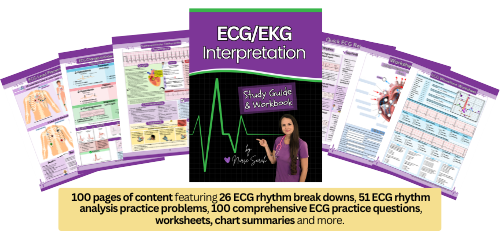
ekg ecg interpretation, ecg ekg study guide, nurse sarah, ecg workbook

“ECG/EKG Interpretation Study Guide and Workbook by Nurse Sarah”. This book contain 100 pages of content featuring 26 ECG rhythm break downs, 51 ECG rhythm analysis practice problems, 100 comprehensive ECG practice questions, worksheets, chart summaries, and more.

You can get an eBook version here: “Nurse Sarah ECG Book” or a physical copy here: “ECG/EKG Interpretation Study Guide by Nurse Sarah“.

Heart Sounds Quiz

1.       S1 is best heard where? A.      2nd intercostal space left of the sternal border B.      2nd right sternal border C.      Apex of the heart D.      Base of the heart 2.       S2 is best heard where? A.      Base of the heart B.      5th intercostal space right of the sternal border C.      Apex of the heart D.      Right lower sternal border 3.       The order of heart valve auscultation is the following (starting at the angle of Louis..downward): a.       Pulmonic, aortic, tricuspid, mitral b.      Mitral, tricuspid, pulmonic, aortic c.       Aortic, pulmonic, tricuspid, mitral d.      Tricuspid, pulmonic, aortic, mitral 4.       True or False: The semilunar valves are the tricuspid and mitral valves. 5.       Select ALL the statements that are TRUE: A.      S1 represents the opening of the mitral and tricuspid valves B.      It is best to listen with the bell of the stethoscope for S3 and S4. C.      The pulmonic valve is auscultated on the left of the sternum in 2nd intercostal space. D.      S2 is louder than S1 at the base of the heart. 6.       The ____________ separate the atria and ventricles. A.      Semilunar valves B.      Atrioventricular valves C.      Pulmonic valve D.      Aortic valve 7.       During _______, the ventricles are relaxed and the AV valves are ________ to allow blood to flow through the atria and ventricles. A.      Systole, closed B.      Diastole, opened C.      Diastole, closed D.      Systole, closed 8.       S2 represents the closure of? A.      Aortic and Pulmonic valves B.      Aortic and Mitral valves C.      Mitral and Pulmonic valves D.      Tricuspid and Aortic valves 9.       The contraction phrase of the heart so blood can be pumped through the body’s system and lungs is known as? A.      Diastole B.      Systole C.      Pericardial closure D.      Repolarization 10.   What is a cause of the extra heart sounds known as S3? A.      Atrial “kick” due to resistant ventricles caused by hypertrophic left ventricle B.      Valves defects C.      Mitral Stenosis D.      Ventricle filling due to fluid volume overload or heart failure 11.   S3 is heard? A.      After S2 B.      Before S2 C.      After S1 D.      Randomly 12.   S4 is heard? A.      During diastole B.      Over the aortic valve C.      Before S1 D.      After S2 13.   Which of the following conditions can cause the extra heart sound S4? A.      Fluid volume overload B.      Fluid volume deficient C.      Hypertrophic left ventricle D.      Aortic regurgitation 14.   What is the best way to assess for extra heart sounds, such as S3 and S4? A.      Place the patient on their right side and listen with the diaphragm of the stethoscope over the apex of the heart. B.      Place the patient on their left side and listen with the bell of the stethoscope over the base of the heart. C.      Place the patient forward (leaning slightly) and have them exhale while listening with the diaphragm over the aortic and pulmonic areas. D.      Place the patient on their left side and listen with the bell of the stethoscope over the apex of the heart. 15.   While auscultating heart sounds you heard a blowing/swooshing noise over the apex of the heart. You note when you lift up the chest piece of the stethoscope you can still hear the sound through the ear pieces (a thrill is also present as well). You would grade this heart murmur as: A.      Grade 4 B.      Grade3 C.      Grade 6 D.      Grade 1 16.   In order to auscultate for an aortic regurgitation heart murmur, what is the best position to place the patient in? A.      Place the patient in a supine position B.      Turn the patient onto their left side C.      Have the patient sitting-up, leaning forward D.      Turn the patient onto their right ride 17.   True or False: S1 split is due to the asynchronous closing of the aortic and pulmonic values. 18.   S1 split can be caused by which of the following: A.      Right bundle branch block B.      Left bundle branch block C.      Ventricular tachycardia D.      Asystole Answer Key: 1. C 2. A 3. C 4. False 5. B, C, D 6. B 7. B 8. A 9. B 10. D 11. A 12. C 13. C 14. D 15. C 16. C 17. False 18. A Don’t forget to tell your friends about this quiz by sharing it your Facebook, Twitter, and other social media. You can also take more fun nursing quizzes. *Disclaimer: While we do our best to provide students with accurate and in-depth study quizzes, this quiz/test is for educational and entertainment purposes only. Please refer to the latest NCLEX review books for the latest updates in nursing. This quiz is copyright RegisteredNurseRn.com. Please do not copy this quiz directly; however, please feel free to share a link to this page with students, friends, and others.

Please Share:

  • Print (Opens in new window) Print
  • Share on Facebook (Opens in new window) Facebook
  • Share on X (Opens in new window) X
  • Share on Pinterest (Opens in new window) Pinterest
  • More
  • Share on Reddit (Opens in new window) Reddit
  • Share on LinkedIn (Opens in new window) LinkedIn
  • Share on WhatsApp (Opens in new window) WhatsApp
  • Share on Telegram (Opens in new window) Telegram

Nursing Notes

Nursing School Bundles Notes by Nurse Sarah

RSS Latest YouTube Videos

  • Hepatitis B Vaccine, Symptoms, Treatment Nursing STI NCLEX Review
  • Deep Tendon Reflexes in 8 Seconds #nursing #nurse #nclex
  • HIV Opportunistic Infections Made Easy for Nursing School & NCLEX
  • Nursing Vascular System Medical Terminology to Know #shorts

Recent Posts

  • STI/STD NCLEX Review Questions – COMPREHENSIVE
  • Hepatitis B NCLEX Practice Questions
  • Order of Draw Phlebotomy Quiz Questions
  • Insulin Types Explained: Onset, Peak, Duration (Ultra-Rapid, Rapid, Short, Long-Acting)
  • NCLEX Practice Questions: Infection Control and Safety

Disclosure and Privacy Policy

This website provides entertainment value only, not medical advice or nursing protocols. We strive for 100% accuracy, but nursing procedures and state laws are constantly changing. By accessing any content on this site or its related media channels, you agree never to hold us liable for damages, harm, loss, or misinformation. See our full disclosure and privacy policy.

Important Links

  • Advertise
  • Contact Us

Follow Us on Social Media

  • Facebook Nursing
  • Instagram Nursing
  • TikTok Nurse
  • Twitter Nursing
  • YouTube Nursing

Copyright Notice

All images, articles, text, videos, and other content found on this website are protected by copyright law and are the intellectual property of RegisteredNurseRN.com or their respective owners.

Copyright © 2026 RegisteredNurseRN.com. All Rights Reserved.