Tourniquets are used by nurses and other healthcare professionals when performing phlebotomy, such as lab draws or blood donations, as well as when starting IVs. Tourniquets are used to help make the veins more visible or palpable, and in the case of blood donation, they can also add venous pressure to allow the blood donation bag to fill more quickly.
Tourniquet Use in Phlebotomy (Blood Draw) Procedures
Here are some important tips on using tourniquets (watch the video above for step-by-step directions):
Prepare for the procedure: Gather your supplies, perform hand hygiene, verify your facility’s protocols, and inform the patient of the procedure.
Tourniquet positioning: Apply the tourniquet around 3-4 inches above the insertion site. This is roughly the width of a palm on an average adult’s hand. For example, if you are drawing blood from the antecubital region, place the tourniquet proximally 3-4 inches (on the arm).

Tourniquet sizing: Some patients may have excess skin, causing the tourniquet to twist around or sink into the skin too far. Bariatric tourniquets, which are longer and wider, may be a better fit for these patients.

How to tie the tourniquet: To tie a tourniquet, place the tourniquet band around the back side of the limb, pull each end to create the desired tension, then cross the tourniquet ends at the front of the limb to form an “X.”
Loop a small section under the X you created. The tourniquet should now stay in place. Ensure that the tourniquet band rests flat on the skin and is not twisted.

Tourniquet tightness: The tourniquet should be tight enough to decrease blood flow without affecting arterial circulation. It should not be painful for the patient, nor should it be so loose that blood flow is unhindered.
If a patient has a lot of body hair or sensitive skin, you may want to wrap the tourniquet around clothing or a thin towel to protect the skin.
Fists vs. pumping: Pumping the fist should be avoided when drawing blood for labs, as this could alter some lab results such as potassium and calcium.
However, holding a fist is generally okay for lab draws as long as the tourniquet is in place. Instruct the patient to relax their fist once the tourniquet is released.
Tourniquet timing: The tourniquet should not be left on for long periods due to the risk of hemoconcentration, which could affect lab results. The key time to remember is 1 minute.
If you are palpating for a vein and the tourniquet has been on for more than 1 minute, release it to allow blood flow again for a couple of minutes, then reapply the tourniquet before insertion. After inserting the needle and seeing blood flow, remove the tourniquet.
However, if the patient shows signs of dehydration, has a poor vascular system, or other factors that could lead to a failed blood draw, keeping the tourniquet on for up to 1 minute as you collect the specimen is acceptable. Leaving it on for more than 1 minute could lead to inaccurate lab results.
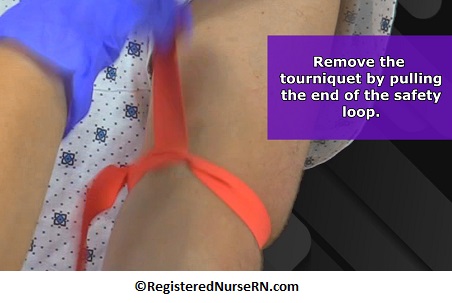
Releasing the tourniquet: Once you’re ready, you’ll want to remove the tourniquet. To release the tourniquet, grab the safety loop you created when you applied the tourniquet, and it should easily pop off.
Avoiding tourniquets: Always verify your facility’s protocols before applying a tourniquet, as some lab draws, such as a lactate level, may contraindicate the use of a tourniquet.